Cross-System Record Reconciliation: An Automated, Secure Data Exchange Between GIS and Operational Systems
Two teams keep records about the same circuits: ours, GIS Application and Automation, and a software team whose systems run day-to-day operations. Each team works in its own tools, and behind them circuit status is refreshed through different APIs at different frequencies.
That timing gap is normal, but it means the two systems can briefly tell different stories. A circuit may be in service on one side while the other hasn’t picked up a status yet, or deactivated on one side while the other still lists it as in service. Now and then a manual entry adds a difference of its own. Keeping the two aligned needs a bridge between them.
Our record
- Circuit ID
- DEMO-0412-B
- Region
- Greater Toronto Area
- Status
- In service
- Last updated
- Jun 18
Their record
- Circuit ID
- DEMO-0412-B
- Region
- Greater Toronto Area
- Status
- None
- Last updated
- Jun 11
In service on one side, no status at all on the other. The two systems update on different schedules, and the newer state hasn't reached the second one yet.
Why a bridge
A difference that nobody looks for doesn’t stay small. Without a regular comparison, differences build up quietly, and the longer one sits, the more likely someone downstream works from the version that’s behind.
Hover or tap the chart to read a day.
The exchange
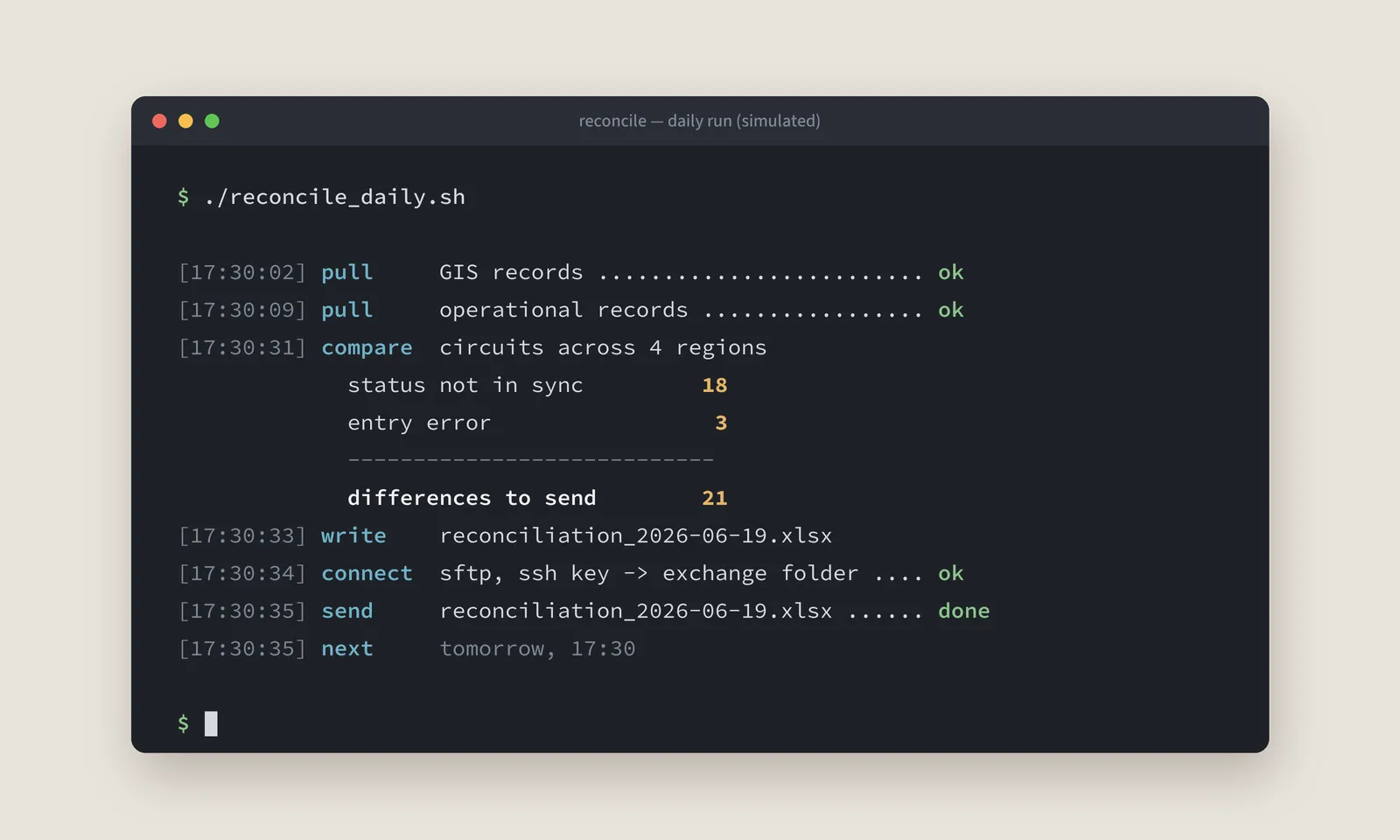
Four steps: pull, compare and send happen on our side; the update happens on theirs. Because these records carry internal details, this exchange runs over an encrypted SFTP connection rather than email or a shared folder.
The latest records to compare are downloaded from the reporting tools.
The file is the agreement between the two teams. Neither team has to work inside the other’s systems; the only shared point is one folder on their server.
What changed
The pipeline runs daily across the Greater Toronto Area, Montreal, Vancouver, and Ottawa, identifying record discrepancies and securely passing them to the team responsible for updates. It has been in place since 2025, helping both teams catch inconsistencies before they accumulate.
Greater Toronto Area
59 differences this week
Status not in sync Entry error
Each difference goes to the team that owns the record, close to when it appears, so the two systems stay aligned day to day rather than drifting apart.
It works alongside the weekly capacity reports: those get our own numbers to the people who need them; this keeps two teams’ records in line. Both depend on the data being right in the first place, which is what spatial validation of splice sequences is for.
Next steps
- Measure the loop. Track how long each difference takes to resolve, not only how many are found.
- Compare more fields. Extend the check beyond IDs and status to the other details both teams keep.
- Shared infrastructure. Run the exchange on shared, always-on infrastructure, and have the receiving side flag any day when no file arrives.